
Published February 25, 2026
The Ghost in the Photograph: Rediscovering the Moments You Forgot Happened
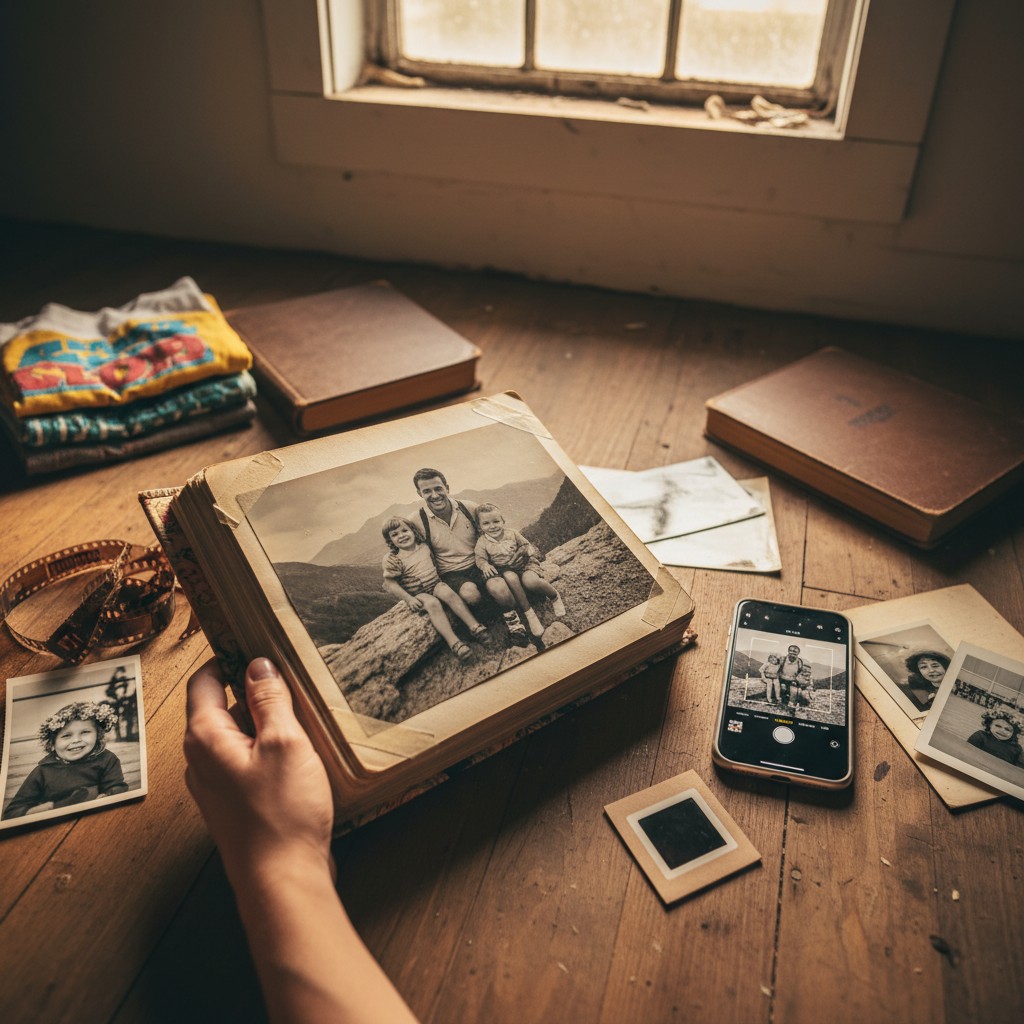
You’re cleaning out the attic on a rainy Saturday, sifting through boxes that haven’t seen the light of day in years. Tucked beneath a stack of old yearbooks and a questionable collection of concert t-shirts, you find it: a thick, slightly warped photo album with a faded floral cover. You sit down on the dusty floor, crack it open, and the faint, specific scent of old paper and adhesive hits you. And then you see it.
It’s not a photo of your wedding day, your graduation, or the birth of your first child. Those memories are etched into your mind, polished and revisited so often they shine. No, this photo is different. It’s a picture of you, maybe seven or eight years old, sitting on a garish orange-and-brown plaid couch that you have no recollection of ever owning. You’re holding a half-eaten popsicle, and your two front teeth are conspicuously absent. Next to you sits your grandfather, not as the frail, elderly man you remember from his final years, but vibrant and laughing, a newspaper folded on his lap. You’re both looking at something off-camera, sharing a joke that is now lost to time.
For a full minute, you just stare. You don’t remember this couch. You don’t remember this specific afternoon. You had completely and utterly forgotten this moment ever happened. Yet, here is the proof. A ghost from your past, smiling back at you. This is the unique, almost magical power of photography: its ability to serve as a time capsule for the moments our brains have deemed unworthy of storage.
Why Our Brains Hit 'Delete' on a Perfectly Good Day
It can feel strange, almost unsettling, to be confronted with a piece of your own life that has been completely erased from your memory. Did it really happen if you can’t remember it? The short answer is yes, and the reason you forgot is rooted in the fascinatingly efficient, and sometimes ruthless, way our memory works.
Think of your brain as an incredibly sophisticated filing system. Every day, it’s inundated with a torrent of information—sights, sounds, conversations, and feelings. To prevent a total system overload, it has to make decisions about what’s important enough to keep. Major life events, emotionally charged experiences, and frequently repeated information get tagged as "high priority" and are consolidated into long-term memory. These are your "greatest hits" album: the wedding, the graduation, the big promotion.
But what about the quiet, everyday moments? The lazy Tuesday afternoon, the car ride to the grocery store, the silly face you made at your brother across the dinner table? These moments, while pleasant, often lack the emotional punch or novelty to be flagged as essential. Our brains, in their quest for efficiency, tend to let these memories fade. They aren't truly deleted, but rather filed away in a deep, inaccessible archive without a clear retrieval path. That is, until a powerful cue comes along. A photograph is perhaps the most potent retrieval cue in existence. It doesn’t just remind you of a fact; it provides a rich, visual, and emotional context that can unlock the entire forgotten scene. Suddenly, the plaid couch isn’t just a couch—you can almost feel its scratchy texture. The popsicle isn’t just a prop—you can almost taste the artificial grape flavor. The photo is the key that unlocks the dusty archive.
A Gallery of Forgotten Gems
The photos that jolt our memories are rarely the ones we’d frame and put on the mantelpiece. They are the outtakes, the "in-between" shots, and the candid captures that reveal more about our lives than any perfectly posed portrait ever could. They tend to fall into a few delightful categories:
- The Unremarkable Day, Made Remarkable by Time: This is the photo of a simple backyard barbecue on a random Sunday. At the time, it was just another weekend. But looking back 20 years later, the photo is imbued with a powerful sense of nostalgia. You see the youthful faces of your parents, the long-gone family dog chasing a ball, the specific style of patio furniture that screams "the 90s." The photo transforms a forgotten afternoon into a perfect, poignant representation of an entire era of your life.
- The "Wait, I Owned That?": We all have them. A photo surfaces revealing a fashion choice so bold, so questionable, you can’t help but laugh. That pair of ridiculously baggy jeans, a t-shirt with a bizarre slogan, or a haircut that defies the laws of physics. These images are snapshots of our former selves, charting our evolution in taste and style. They remind us that the person we are today is built upon a foundation of many, sometimes embarrassing, past versions.
- The Forgotten Cast of Characters: You’re looking at a group photo from an old office party or a childhood birthday. You recognize yourself, but who is that person standing next to you, arm slung around your shoulder like you were best friends? The photo acts as a trigger, and slowly, the name and the stories come flooding back. It’s a reminder that our lives are a tapestry woven with threads of countless relationships, some lifelong and others fleeting, but all of which contributed to the person we became.
- The Candid Chaos: These are the messy, imperfect, and utterly authentic photos. The kitchen covered in flour after a baking experiment with the kids. The living room floor littered with wrapping paper on Christmas morning. The blurry photo of you tripping during a family race in the park. These aren't the highlight-reel moments, but they are the real moments. They capture the beautiful, chaotic texture of a life being lived, not just performed for the camera.
From Shoebox to Story: Preserving Your Forgotten Moments
The tragedy is that so many of these priceless visual cues are languishing in the dark. They’re trapped in shoeboxes, stuck to the sticky pages of decaying albums, or sitting in a carousel of slides nobody has the equipment to view anymore. They are fragile, susceptible to fading, water damage, and being lost forever. The moments they hold are in danger of being permanently forgotten.
This is why the act of digitizing old photos is so much more than just creating a backup. It’s an active process of rediscovery. As you go through this process, perhaps using a tool like the Photomyne app to scan entire album pages at once, you're not just archiving—you're curating your own personal history. Each scan can unearth a moment you haven't thought about in decades, instantly bringing a forgotten afternoon into sharp, digital focus on your phone screen. It transforms a potential chore into a journey of discovery. You can easily tag the people in the photo, add the date and location as you remember it, and with a single tap, share that rediscovered memory with a sibling or friend who might have forgotten it too, sparking a whole new conversation and a shared trip down memory lane.
By bringing these photos into the digital age, you give them a new life. They are no longer static objects gathering dust; they become dynamic parts of your ongoing story, ready to be shared, cherished, and used to jog your memory for years to come.
So, the next time you have a free afternoon, don't just scroll through your recent camera roll. Dig deeper. Open that dusty album. Pull that shoebox down from the top shelf of the closet. You might just find a picture of a moment you forgot happened—a moment that was waiting patiently to remind you of a part of your story you never knew you were missing.